
Caitlin Clark is officially headed to the 2026 FIBA Women’s World Cup with the United States, placing one of basketball’s most influential players on the sport’s largest international stage.
Her selection alongside Angel Reese and Paige Bueckers has created a compelling generational story for Team USA.
It has also produced sensational online narratives that attempt to turn three teammates into rivals before the tournament begins.
One widely circulated YouTube transcript claims Clark delivered a thunderous statement before the World Cup and left Reese and Bueckers stunned by the power of her message.
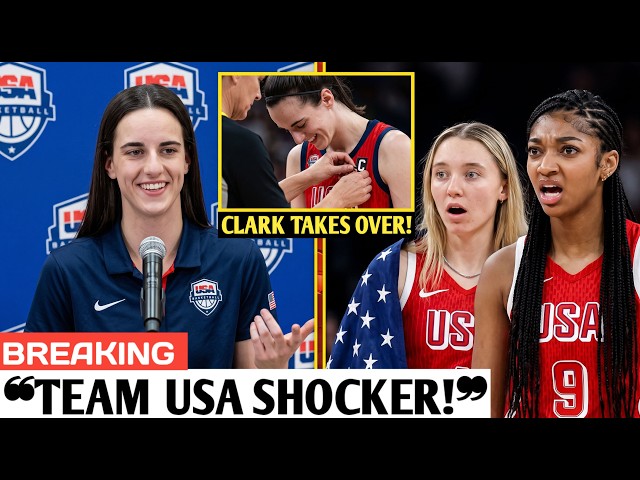
The video describes a tense media room, carefully coded reactions, and an institution supposedly reorganizing itself around Clark.
However, several quotations and behind-the-scenes details presented in the transcript are not accompanied by verifiable primary evidence.
The confirmed story is already significant without treating every dramatic interpretation as fact.
USA Basketball officially announced its 2026 Women’s National Team on August 6.
Clark, Reese, and Bueckers were all selected, joining an accomplished roster preparing to pursue a fifth consecutive World Cup gold medal.
The three young stars will make their World Cup debuts alongside other newcomers, while established champions provide experience and continuity.
That combination creates a genuine transition point for the American program.
Clark enters the tournament with an audience and cultural reach rarely associated with a first-time senior World Cup participant.
Her passing vision, shooting range, transition speed, and ability to control tempo give Team USA tactical possibilities that extend beyond ordinary roster depth.
Official USA Basketball records show that Clark already contributed during the 2026 World Cup qualifying tournament.
She helped the United States finish 5-0 while averaging 11.6 points and a team-leading 6.4 assists across five games.
In her senior national-team debut, Clark recorded 17 points and 12 assists as the United States opened qualifying with a victory.
Those performances provide real evidence that she can influence international basketball without relying on anonymous practice stories or invented controversy.
The viral transcript nevertheless builds its central argument around an alleged pre-World Cup media availability in Chicago.
According to the narrator, reporters initially received predictable answers about national pride, difficult competition, and the honor of representing the United States.
The atmosphere supposedly changed when Clark reached the podium.
The transcript attributes a long quotation to her about creating a version of USA Basketball that has never existed before.
She allegedly emphasized building something new rather than replacing the achievements of earlier teams.
On its surface, the supposed message is diplomatic and team-oriented.
The video, however, interprets nearly every phrase as a strategic declaration of power.
It claims Clark’s reference to having everybody available was an unmistakable response to her exclusion from the 2024 Paris Olympic roster.
It further argues that her language about building something new amounted to an announcement that the program had entered her era.
That interpretation might generate discussion, but it depends on the authenticity and context of the quotation.
The supplied transcript does not provide a direct link to a complete official recording containing those exact remarks.
Without that evidence, a responsible article cannot present the alleged statement as confirmed.
The transcript uses the same method when describing Reese’s reaction.
Reese is quoted as focusing on her own game and insisting that podium comments matter less than performance between the lines.
The narrator acknowledges that the alleged answer is reasonable, then portrays it as evidence that Reese refused to support Clark’s vision.
That is a highly subjective reading.
An athlete emphasizing preparation and on-court performance does not automatically signal jealousy, division, or resistance to a teammate’s leadership.
Competitive players regularly redirect broad media questions toward the elements they can personally control.
The video nevertheless frames Reese’s supposed answer as an individual response to Clark’s growing institutional gravity.
It turns restraint into rivalry and professional focus into a struggle for positioning.
That approach is especially effective online because Clark and Reese have been connected by a powerful public narrative since their college careers.
Their teams met in the 2023 national championship game, and subsequent professional matchups intensified the attention surrounding them.
Fans, commentators, and content creators frequently interpret ordinary interactions through the lens of that rivalry.
The World Cup offers another setting where the more meaningful story may be collaboration rather than conflict.
Clark’s passing and Reese’s rebounding could complement each other naturally.
Clark creates defensive movement and open lanes, while Reese’s energy around the basket can generate second opportunities and punish opponents who lose track of interior positioning.
Their ability to combine those strengths matters more to Team USA than speculative analysis of facial expressions or interview wording.
Bueckers receives similar treatment in the transcript.
She is allegedly quoted as praising Clark’s impact while adding that the national team does not need to belong to one person.
The narrator calls this the quiet part spoken aloud and argues that Bueckers must already feel pulled into Clark’s orbit.
Once again, the conclusion goes far beyond the alleged quotation.
A statement about shared opportunity can express confidence in a roster filled with elite players rather than anxiety about one teammate’s popularity.
Team USA has historically relied on exceptional depth, adaptable roles, and the willingness of stars to accept fewer individual opportunities than they receive with professional clubs.
That culture makes collective language entirely appropriate.
Bueckers, Clark, and Reese enter the World Cup with different strengths, experiences, and public identities.
Their presence does not require a hierarchy manufactured through viral clips.
It requires coaches to define roles that protect team balance while allowing each player’s distinctive skills to appear.
The transcript then moves from player reactions to an ambitious theory about economics.
It claims USA Basketball and FIBA have organized marketing projections around a single primary audience driver.
Although the narrator does not identify that player in the alleged report, the video clearly assumes the name is Clark.
There is a credible foundation beneath the broader commercial argument.
Clark has drawn extraordinary television audiences, increased ticket demand, and expanded interest in women’s basketball among viewers who previously followed the sport only occasionally.
Her first World Cup appearance will naturally attract broadcasters, sponsors, and international fans.
Nevertheless, the transcript cites supposed internal marketing tiers and rights negotiations without providing documents or directly accessible reporting that confirms the details.
The existence of Clark’s commercial power does not verify every claim made about how institutions intend to use it.
The narrator further argues that Clark consciously shaped her public language over several months.
In this telling, she moved from hoping for an opportunity in February to implying that her selection was inevitable in May.
By August, the video claims, she had transformed from a candidate into the architect of Team USA’s future.
That is elegant storytelling, but it remains an interpretation constructed from remarks that require verification.
Athletes often answer similar questions differently as circumstances change.
A growing sense of confidence does not necessarily prove a coordinated strategy to seize institutional authority.
The transcript presents Clark as uniquely aware of the architecture of attention.
It suggests she knows precisely which sentences will become clips and how each public appearance can move the wider conversation.
Clark has undoubtedly demonstrated composure under intense scrutiny.
She regularly speaks before large media groups and understands that her comments travel far beyond the original room.
Still, claiming knowledge of her private intentions requires stronger evidence than observing the effectiveness of a supposed sound bite.
One of the video’s most provocative arguments concerns winners and losers.
Clark is declared the program’s new public voice, while Reese is portrayed as losing position and Bueckers as becoming a diplomatic bridge.
USA Basketball is said to benefit from Clark’s promotional weight while surrendering long-term authority to her influence.
This framework turns a national team announcement into a political contest.
It may be useful for generating engagement, but it oversimplifies how elite teams operate.
Leadership can be distributed across performance, experience, communication, defensive responsibility, and situational decision-making.
The loudest commercial figure does not automatically control every basketball decision.
Likewise, a player with fewer followers does not become less valuable when competition begins.
The United States roster contains athletes capable of changing games in sharply different ways.
Some will lead through scoring, others through defense, rebounding, pace, organization, or composure during difficult moments.
Clark’s visibility may make her the face most familiar to casual audiences.
That does not eliminate the importance of Reese, Bueckers, A’ja Wilson, Napheesa Collier, Breanna Stewart, or the rest of the selected group.
The transcript compares the situation with the 1992 United States men’s Olympic team.
Michael Jordan was its biggest star, yet the program marketed Magic Johnson, Larry Bird, Charles Barkley, and other legends as part of a historic ensemble.
The video argues that women’s basketball cannot reproduce that model because Clark’s crossover audience is substantially larger than the attention surrounding her teammates.
The comparison raises an interesting marketing question, but it does not establish that the ensemble approach is impossible.
A major tournament can introduce casual fans to additional stars precisely because one famous player brings them into the audience.
Clark’s reach could elevate the visibility of teammates rather than reduce them to supporting characters.
Strong performances by Reese or Bueckers may create new fans, new storylines, and new commercial opportunities throughout the competition.
The video predicts three possible outcomes.
The first has USA Basketball embracing Clark as its centerpiece while other young stars accept secondary promotional roles.
The second predicts that Reese or Bueckers will publicly challenge a hierarchical narrative and create media tension before the tournament.
The third imagines coaches imposing strict message discipline to prevent players from speaking freely.
The narrator assigns percentages to each scenario, but those figures are personal estimates rather than results from a transparent forecasting model.
They should be understood as commentary designed to sustain suspense.
The official tournament will provide a better measure of Team USA’s priorities.
Minutes, starting combinations, offensive responsibilities, defensive assignments, and late-game decisions will reveal how the coaching staff understands the roster.
Even then, one exhibition or group-stage game may not define a permanent hierarchy.
International tournaments require adjustments based on opponents, health, form, and matchups.
Clark could control the ball extensively in one contest and work away from it in another.
Reese might become essential against a powerful rebounding team, while Bueckers could provide scoring, secondary creation, or defensive flexibility in a different matchup.
Adaptability is a competitive strength, not evidence of instability.
The most important confirmed development is that all three players have earned places on the 2026 roster.
USA Basketball’s official coverage describes Reese as one of four newcomers to the World Cup or Olympic stage alongside Bueckers, Clark, and Aliyah Boston.
Recent official previews likewise list Clark, Reese, and Bueckers among the American players preparing to compete in Berlin.
That shared opportunity should be the foundation of responsible coverage.
Online audiences should remain skeptical when a video attributes exact quotations to real athletes without linking to complete interviews.
They should also distinguish reporting from interpretation.
A verified statement tells readers what happened, while analysis proposes what that statement might mean.
The viral transcript repeatedly presents interpretations of pauses, word choices, and alleged reactions as though they reveal an undisputed power struggle.
That style can be entertaining, but it can also mislead viewers who encounter only the headline or a short excerpt.
Clark’s rise unquestionably represents an important change in women’s basketball.
She brings extraordinary attention to Team USA and has already shown during qualifying that she can produce efficiently within an international roster.
Reese brings physicality, rebounding, competitive energy, and a growing profile of her own.
Bueckers adds skill, poise, scoring versatility, and the ability to connect different parts of an offense.
The compelling question is not whether Clark stunned or diminished them.
It is whether these prominent young players can help sustain American dominance while introducing a new generation of supporters to the World Cup.
That answer will emerge on the court, not through unverified quotations or speculative rankings of personal power.
The tournament may indeed mark the beginning of a new era for USA Basketball.
If it does, the era will be built through shared preparation, clearly defined roles, and performance under international pressure.
Clark will command enormous attention, but her success will remain connected to the talent surrounding her.
Reese and Bueckers are not merely characters reacting to someone else’s statement.
They are selected national-team players with their own responsibilities, ambitions, and opportunities to influence the result.
Fans have every reason to anticipate Clark’s World Cup debut and debate how the offense should use her rare abilities.
They should also resist headlines that convert teammates into enemies without reliable evidence.
The verified story is powerful enough.
Caitlin Clark, Angel Reese, and Paige Bueckers are preparing to represent the United States together on a global stage.
What they build in Berlin could matter far more than anything an anonymous narrator claims happened behind a podium.
