
BERLIN — Caitlin Clark arrived at the FIBA Women’s Basketball World Cup carrying more attention than perhaps any player making her debut on the international stage.
She responded with basketball.
Fourteen points.
Eleven assists.
Zero turnovers.
And one emphatic Team USA victory.

The United States defeated China 94-61 in Berlin, beginning its pursuit of a fifth consecutive Women’s World Cup championship with a convincing statement.
Clark did not start.
She did not need to start to become the central story.
Coming off the bench, the Indiana Fever guard immediately changed the rhythm of the American offense and delivered one of the most memorable World Cup debuts by a United States player.
Her 11 assists established a Team USA record for assists by a player making her Women’s World Cup debut.
More importantly, Clark reached that total without committing a single turnover.
For a player known for aggressive passing and ambitious offensive creation, that combination was extraordinary.
CAITLIN CLARK ENTERS FROM THE BENCH.
Head coach Kara Lawson opened with an experienced starting lineup rather than immediately placing Clark among the first five.
Chelsea Gray started at point guard.
Jackie Young joined her in the backcourt.
Breanna Stewart, Napheesa Collier and Kahleah Copper completed the veteran-heavy starting group.
Clark waited.
The decision generated debate before the opening possession because of the enormous attention surrounding her World Cup arrival.
But Lawson had legitimate basketball reasons to value experience.
Gray has played championship basketball at virtually every level.
Stewart has already won multiple World Cup gold medals.
Team USA traditionally possesses enough depth to change lineups without dramatically changing its overall talent level.
Then Clark entered.
FOUR ASSISTS IN FOUR MINUTES.
The effect was immediate.
According to FIBA, Clark recorded four assists during her first four minutes of World Cup action.
That statistic captures the most important element of her debut.
Clark was not chasing points.
She was creating them.
The ball moved faster when she recognized an opening.
Teammates received passes before China could completely adjust its defensive positioning.
Transition opportunities became more dangerous.
Half-court possessions became less predictable.
Clark entered the game with a clear priority.
Facilitate.
Push the pace.
Penetrate the defense.
Find teammates.
She later explained that those areas had been central to her approach against China’s defensive structure.
CHINA PRESENTED AN UNUSUAL PHYSICAL CHALLENGE.
China was not an ordinary opening opponent.
The Americans faced extraordinary size inside.
Zhang Ziyu, the towering 19-year-old center, presented a physical matchup unlike almost anything the United States regularly encounters.
Zhang stands approximately 7-foot-3.
Han Xu provided additional size.
That combination gave China a significant interior presence and forced Team USA to think carefully about how it attacked the paint.
Clark helped create a natural answer.
Speed.
Instead of repeatedly allowing China’s biggest defenders to remain planted around the basket, Team USA could force them to react in space.
That meant moving the ball quickly.
It meant attacking before the defense settled.
And it meant stretching China farther away from the rim.
CLARK’S SHOOTING RANGE CHANGES THE FLOOR.
Clark finished with three made three-pointers.
Those shots were important beyond the nine points they produced.
Defensive geometry changes when Clark begins making deep shots.
A traditional guard can sometimes be defended near the three-point line.
Clark frequently requires attention several feet beyond it.
That creates uncomfortable choices.
Move a defender toward Clark and additional space appears elsewhere.
Keep defenders closer to the paint and Clark can shoot.
Send extra pressure toward her and she can pass into the advantage created behind the defense.
China confronted those decisions throughout the game.
ELEVEN ASSISTS PUT CLARK IN ELITE WORLD CUP COMPANY.
Clark’s final assist total was historically significant.
FIBA’s official records show only a small collection of players producing more than ten assists in a Women’s World Cup game since assists began being officially tracked in 1994.
Julie Allemand reached 13.
Yuka Harada reached 13.
Dawn Staley recorded 12 for the United States against Russia in 1998.
Clark finished with 11.
She joined that elite group during her first World Cup appearance.
But one additional number separated her performance.
Zero turnovers.
ZERO TURNOVERS MAY BE THE MOST IMPRESSIVE STATISTIC.
Point guards live with risk.
Every aggressive pass creates potential reward and potential disaster.
International competition makes those decisions even more difficult.
Defenders are physical.
Passing windows disappear quickly.
Zone defenses can create unusual angles.
Traps arrive from different directions.
Clark produced 11 assists without giving China a single turnover.
That demonstrated far more than creativity.
It demonstrated control.
There was speed without recklessness.
There was ambition without carelessness.
There was confidence without forcing every possession.
That balance could prove extremely valuable for Team USA during the remainder of the tournament.
RHYNE HOWARD PUNISHES CHINA FROM DEEP.
Clark was hardly operating alone.
Rhyne Howard scored 14 points and provided another dangerous perimeter threat.
Howard made four three-pointers.
Her shooting created precisely the kind of partnership that enhances Clark’s playmaking.
When Clark draws defensive attention, shooters gain space.
When defenders refuse to leave Howard, Clark has additional room to penetrate.
The relationship forces opponents into difficult choices.
Choose Clark.
Howard can punish the decision.
Choose Howard.
Clark can attack.
That is the advantage of surrounding an elite playmaker with elite shooting.
PAIGE BUECKERS DELIVERS IN THE SECOND HALF.
Paige Bueckers also finished with 14 points.
Her performance developed differently.
Early foul trouble limited her first-half opportunities.
Then she found her rhythm.
Bueckers scored efficiently and became increasingly dangerous as the second half progressed.
Her combination with Clark was particularly intriguing.
After the game, Lawson specifically discussed how well the two guards played together against China’s zone.
Both can stretch the floor.
Both can create.
Both can attack gaps.
That gives Team USA several ways to initiate offense without becoming predictable.
CLARK AND BUECKERS REPRESENT A DIFFERENT KIND OF BACKCOURT.
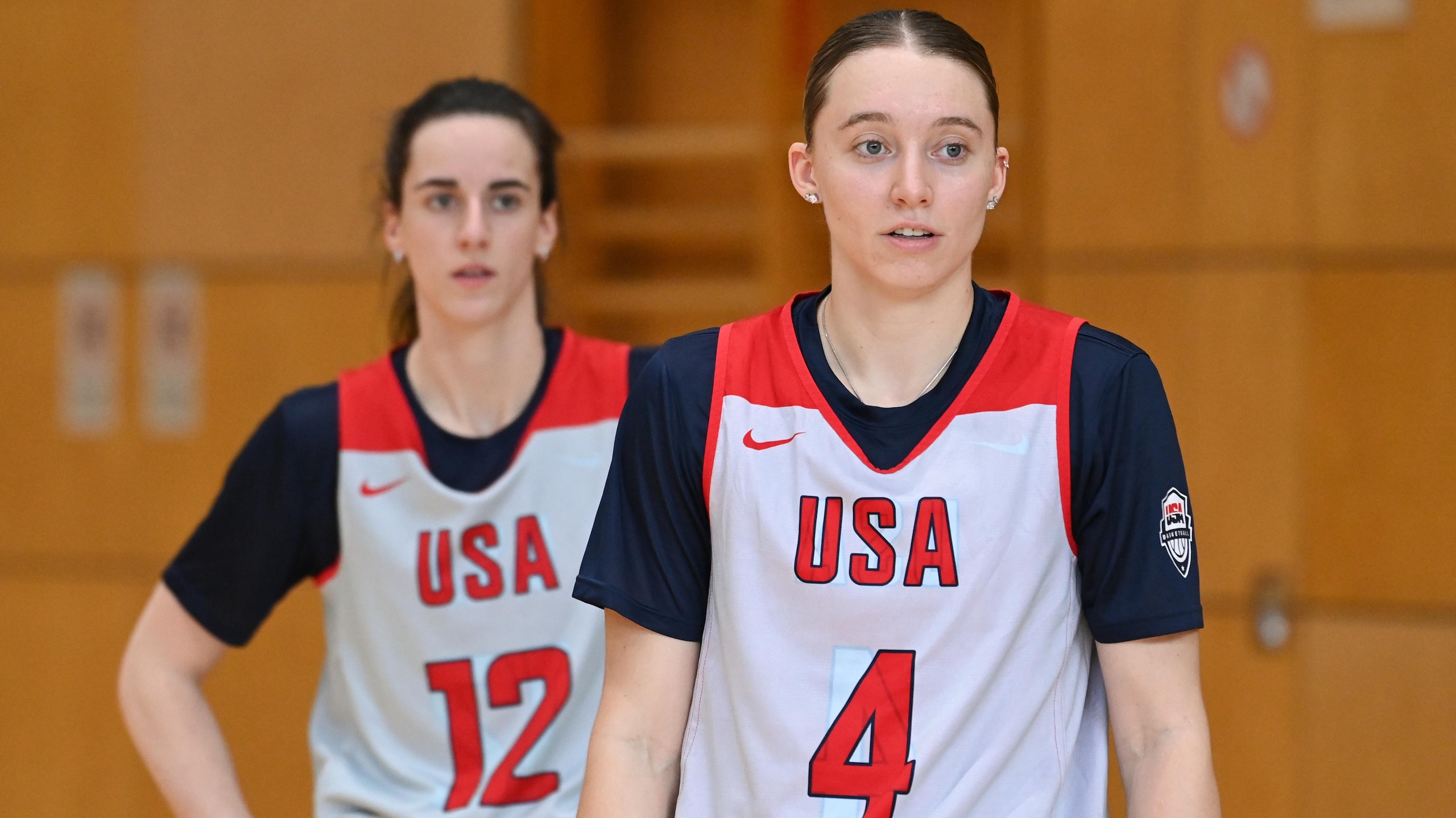
The two guards do not play identical basketball.
That is precisely why the partnership can work.
Clark threatens defenses from extraordinary distance.
Her passing often creates opportunities before a possession appears fully developed.
Bueckers can operate beautifully in the mid-range.
She manipulates smaller spaces.
She changes speeds.
She can attack after Clark has already forced the defense to shift.
Together, they create multiple layers of pressure.
One defender cannot solve both problems.
One defensive scheme may not be enough either.
TEAM USA’S DEPTH OVERWHELMS CHINA.
The United States eventually turned the game into a rout.
The final margin reached 33 points.
USA scored 94.
China finished with 61.
The Americans received production throughout the roster.
Howard scored.
Bueckers scored.
Clark scored.
Young attacked.
Stewart provided experience and versatility.
Aliyah Boston battled China’s enormous frontcourt.
Angel Reese attacked the glass.
This was not one player defeating China.
It was an extraordinarily deep roster finding multiple solutions.
Clark simply became the player connecting many of those solutions.
LAWSON PRAISES WHAT CLARK AND BUECKERS CREATED.
The source video portrays Lawson’s postgame praise as some kind of forced surrender to Clark.
The verified comments do not justify such dramatic language.
What Lawson did acknowledge was the effectiveness of the younger guards.
She specifically praised how Clark and Bueckers worked together against the zone.
Lawson pointed toward their ability to stretch the floor, playmake and attack defensive gaps.
That was straightforward coaching analysis.
It was not an admission of wrongdoing.
It was recognition of what worked.
And for Team USA, identifying what works is far more important than winning an online argument about the starting lineup.
SHOULD CAITLIN CLARK START?
The question will not disappear.
Clark’s performance guarantees that.
A player producing 14 points, 11 assists and zero turnovers naturally creates a strong case for greater responsibility.
But national-team basketball is different from professional franchise basketball.
Starting is only one part of the equation.
Minutes matter.
Closing lineups matter.
Possession responsibility matters.
Matchups matter.
Lawson can technically bring Clark from the bench while still allowing her to control major portions of the game.
The important question is whether Team USA maximizes her unique strengths.
Against China, it clearly did for substantial stretches.
THE WORLD CUP STAGE DID NOT OVERWHELM CLARK.
Before the tournament, one legitimate question surrounded Clark.
How quickly would her game translate internationally?
The answer arrived quickly.
Her passing translated.
Her shooting translated.
Her pace translated.
Her ability to manipulate defensive attention translated.
Clark herself acknowledged that facing China’s enormous size created a basketball experience unlike anything she had encountered before.
She adapted anyway.
That may be more encouraging than the raw statistics.
Great international players must solve unfamiliar problems.
Clark solved several during her first game.
THE ATTENDANCE STORY IS ALSO REAL, BUT REQUIRES CONTEXT.
Interest in the 2026 Women’s World Cup has been extraordinary.
FIBA announced before the tournament that more than 200,000 spectators were expected to attend in Berlin.
The final weekend was already sold out.
A separate report put ticket sales above 217,000 on opening day.
Clark is unquestionably one of the tournament’s largest attractions.
However, claiming that every ticket was sold because of her would go beyond the available evidence.
Germany is hosting.
Sixteen national teams are competing.
The tournament contains stars from around the world.
Clark is a major part of the attraction.
She is not the only part.
BERLIN IS BECOMING A SHOWCASE FOR WOMEN’S BASKETBALL.
FIBA also reported a sold-out crowd of 12,550 for Germany’s opening game against Spain.
That atmosphere demonstrated the broader strength of the tournament.
Women’s international basketball is attracting major crowds.
The World Cup has become more competitive.
Global stars are increasingly recognizable.
The WNBA’s international influence continues growing.
Clark’s arrival adds another enormous layer of attention.
But Berlin’s basketball story extends beyond one American player.
That broader growth should not be overlooked.
THEN CAME ANOTHER MAJOR ANNOUNCEMENT.
On September 4, the same day Clark made her World Cup debut, the WNBA announced significant leadership news.
Commissioner Cathy Engelbert will retire at the end of 2026.
The announcement was real.
The timing was striking.
But there is no credible evidence that Clark’s performance against China caused Engelbert’s decision.
There is also no official evidence connecting the retirement announcement to criticism surrounding physical play against Clark.
The WNBA said Engelbert had informed the league of her decision to retire after seven years leading the organization.
ENGELBERT OVERSAW A PERIOD OF EXTRAORDINARY WNBA GROWTH.
The league’s official announcement emphasized the enormous transformation that occurred during Engelbert’s tenure.
WNBA viewership grew.
Attendance reached historic levels.
Franchise values increased.
Corporate partnerships expanded.
The league secured major media-rights agreements.
Expansion accelerated.
The WNBA moved from 12 franchises toward a planned 18 teams by 2030.
NBA Commissioner Adam Silver described Engelbert’s tenure as coinciding with the most significant growth period in league history.
Those facts make the simplistic narrative of a commissioner being “forced out” because of one player impossible to support.
CLARK HAS STILL BEEN CENTRAL TO THE LEAGUE’S RECENT SURGE.
Rejecting an unsupported causal claim does not mean minimizing Clark’s impact.
Her influence on women’s basketball has been enormous.
Her arrival in the WNBA generated unusual levels of television attention, attendance demand and mainstream sports coverage.
Reuters has described Clark as one of the most prominent and widely followed players in American women’s basketball.
Her popularity clearly travels internationally.
Berlin has reinforced that point.
Clark no longer generates attention only in Indianapolis, Chicago, New York or Las Vegas.
Her audience is global.
THE WORLD CUP OFFERS A DIFFERENT KIND OF TEST.
Popularity cannot win an international championship.
Basketball must.
That is what makes Clark’s Berlin performance more significant than another attendance statistic.
She had to play.
She had to execute.
She had to solve China’s defense.
She had to make decisions against unfamiliar opponents.
She did.
Fourteen points and 11 assists provided the headline.
Zero turnovers provided the substance.
Clark did not need a marketing campaign to justify the attention that night.
Her performance did it.
THERE IS NO VERIFIED EVIDENCE OF A SYSTEM DESIGNED TO SUPPRESS HER.
The source transcript repeatedly describes an organized system attempting to hold Clark down.
That claim is not established by reliable reporting.
There is no verified evidence Lawson created a game plan specifically to suppress Clark.
There is no credible evidence the WNBA instructed officials or teams to allow opponents to target her.
There is no evidence Engelbert’s retirement resulted from Clark’s World Cup performance.
Those theories may generate dramatic videos.
They should not be presented as reported facts.
The confirmed basketball story is powerful enough.
CLARK DID NOT NEED A “REVENGE” NARRATIVE.
This is perhaps the most important point.
Clark did not need Berlin to become an act of revenge.
She needed it to become another basketball challenge.
She entered from the bench.
She found teammates.
She made shots.
She pushed pace.
She adapted to China’s size.
She recorded 11 assists.
She protected the basketball.
Team USA won by 33.
That sequence already creates an extraordinary story.
Inventing enemies only weakens it.
TEAM USA’S NEXT CHALLENGE IS BUILDING ON THE PERFORMANCE.
One opening victory does not determine a World Cup champion.
Opponents will study Clark.
They will examine how China defended her.
They will pressure passing lanes differently.
They may trap aggressively.
They may force her toward uncomfortable areas.
They may refuse to allow the transition opportunities China surrendered.
Clark will have to adjust again.
So will Lawson.
That tactical battle is what makes the tournament interesting.
THE STARTING-LINEUP DEBATE WILL CONTINUE.
Gray’s experience remains valuable.
Clark’s creativity is undeniable.
Bueckers provides another elite option.
Team USA does not need to choose a philosophical side forever.
It needs the correct combinations for each opponent.
Perhaps Clark eventually starts.
Perhaps she remains an unusually powerful weapon off the bench.
Perhaps the lineup changes throughout the tournament.
What happened against China provides Lawson with valuable evidence.
When Clark controls pace and surrounds herself with finishers, USA can become extremely difficult to defend.
CAITLIN CLARK HAS ALREADY LEFT HER FIRST WORLD CUP MARK.
There will be larger games ahead.
There may be more dramatic performances.
There may also be difficult nights.
But Clark’s World Cup debut is already permanent.
Fourteen points.
Eleven assists.
Three three-pointers.
Zero turnovers.
TCL Player of the Game.
A 94-61 Team USA victory.
And a new American debut assist record.
That is history without exaggeration.
BERLIN WAS A BEGINNING, NOT A CORONATION.
The temptation after a performance like this is to declare everything settled.
It is not.
Clark has not won the World Cup yet.
Team USA has not completed its pursuit of a fifth consecutive championship.
The starting-lineup discussion remains open.
The international defenses will become more prepared.
But something important did happen against China.
Clark proved she belongs on this stage.
Not because of ratings.
Not because of ticket sales.
Not because of social-media arguments.
Because of basketball.
She entered her first FIBA Women’s Basketball World Cup game and controlled large stretches of it with vision, pace and remarkable precision.
On a day when the WNBA separately announced the coming retirement of commissioner Cathy Engelbert, Clark produced another major milestone of her own.
The two events happened on the same date.
There is no evidence one caused the other.
The verified story is simpler.
The WNBA is entering another period of transition.
Team USA is attempting to extend an international dynasty.
And Caitlin Clark has arrived at her first Women’s World Cup looking completely capable of becoming one of its defining players.
Berlin did not prove that everyone who ever doubted Clark was wrong.
It proved something more useful.
When the ball reached her hands on the biggest international stage of her career, Caitlin Clark was ready.
And she let 14 points, 11 assists, zero turnovers and a 33-point American victory do the talking.
