
Did Angel Reese Quit Team USA Practice?
Angel Reese quit Team USA practice after Caitlin Clark allegedly delivered a dominant performance during the second day of national-team training, according to a viral video spreading across social media.
The headline says Clark humiliated the roster, destroyed the established hierarchy, and pushed Reese beyond her breaking point.
It is an explosive story involving two of women’s basketball’s most recognizable stars.
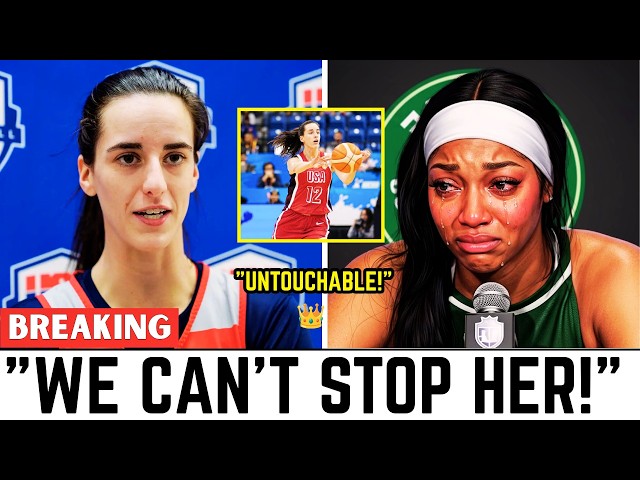
However, the available evidence does not confirm its most serious allegation.
The video describes a closed USA Basketball practice led by head coach Kara Lawson.
According to its narrator, veteran players entered the session determined to test Clark physically and prevent her from controlling the offense.
The story claims they used hard contact, aggressive traps, and intense defensive pressure to force her away from her preferred style.
Clark allegedly responded by taking complete control of the scrimmage.
The narrator says she made deep three-pointers, escaped double teams, delivered rapid no-look passes, and repeatedly exposed defenders who could not adjust to her pace.
One supposed possession becomes the emotional center of the story.
Clark is said to have pushed the ball in transition while three defenders collapsed toward her near the three-point line.
Reese allegedly stepped forward to stop the drive, but Clark suddenly changed direction and created enough space to launch a difficult shot.
The ball supposedly fell cleanly through the net as the gym became silent.
The video claims coaches lowered their clipboards and veteran players stared at one another in disbelief.
It presents the moment as proof that the future of American basketball had arrived and the previous power structure could no longer survive.
That description is cinematic, precise, and designed to be unforgettable.
It is not accompanied by complete practice footage, official statistics, or testimony from an identified witness.
The absence of those elements is important because the practice was described as closed to the public.
When an event cannot be viewed independently, the credibility of the sources becomes essential.
The video repeatedly refers to insiders and eyewitnesses, but it does not name them or explain why they should be trusted.
Its most controversial claim appears immediately after the alleged shot over Reese.
The narrator says Reese became visibly angry, removed her practice jersey, threw it toward the bench, and walked toward the locker room before the drill finished.
The doors supposedly slammed behind her while coaches and teammates remained frozen on the court.
The video then interprets the alleged departure as a white flag and an admission that Reese could not compete with Clark.
That conclusion goes far beyond the evidence presented.
No official USA Basketball announcement reviewed for this article confirms that Reese quit practice, abandoned the team, or faced discipline for leaving a session.
The video provides no uninterrupted recording of the alleged walkout and no on-record statement from Lawson, Clark, Reese, or another player who attended the practice.
Without such confirmation, the claim that Angel Reese quit Team USA practice should be treated as an unverified rumor rather than established news.
Even if a player briefly left a drill, the reason would matter.
An athlete might receive medical attention, speak privately with a coach, change equipment, or leave because of an issue unrelated to competition.
A temporary exit would not automatically mean the player quit practice or surrendered to a teammate.
The viral video supplies no reliable context establishing what happened before or after the alleged departure.
Official records tell a less sensational but more dependable story.
USA Basketball selected both Caitlin Clark and Angel Reese for the 2026 FIBA Women’s World Cup roster.
The organization presented Reese as one of the players preparing to make her debut at a major senior international tournament.
Clark also entered the World Cup cycle as an important member of the American backcourt.
Both athletes had already contributed during World Cup qualifying, when the United States completed the tournament with a perfect 5-0 record.
Clark’s official USA Basketball profile credits her with averaging 11.6 points and a team-leading 6.4 assists across five qualifying games.
She recorded 17 points and 12 assists in her senior national-team debut, immediately demonstrating that her passing and shooting could influence international competition.
Reese also contributed to the qualifying campaign.
Official coverage highlighted her work during a decisive American scoring run against New Zealand.
Those documented performances show two talented players working toward the same national-team objective.
They do not support the claim that Clark’s success caused Reese to abandon a later practice.
Clark’s ability to dominate stretches of play is entirely believable.
Her shooting range forces defenders to guard areas they usually concede, creating larger spaces behind the initial line of pressure.
Her court vision allows her to locate open teammates as soon as additional defenders move toward the ball.
She can accelerate the pace after rebounds, identify mismatches early, and create scoring opportunities before a defense becomes organized.
Those skills give Lawson several compelling options at the World Cup.
Team USA can allow Clark to initiate early offense, use high screens to create decisions, or position her away from the ball to stretch defensive coverage.
The attention she commands may create more room for powerful interior players and athletic cutters.
Her presence could change how opponents prepare for the United States without requiring every possession to revolve around her.
International tournaments demand flexibility because opponents present different styles, physical profiles, and tactical challenges.
One game may require additional shooting and ball movement, while another may be decided by defense and rebounding.
Clark can become a central creator without diminishing the importance of other players.
Reese offers strengths that can complement Clark rather than compete with her.
Her offensive rebounding can produce extra possessions after long shots, while her speed in transition can reward Clark’s willingness to pass ahead.
Reese can pressure the rim, defend physical frontcourt players, and bring energy during stretches when Team USA needs to change the rhythm of a game.
The more meaningful basketball question is how Lawson combines those abilities.
The viral video instead treats every difference between the players as evidence of hostility.
That framing is effective because Clark and Reese have been connected by a widely promoted rivalry since their college careers.
Their programs met in the 2023 national championship game, and their later professional matchups attracted large television audiences and intense online debate.
Fans often interpret ordinary interactions through that history.
A competitive expression becomes jealousy, a hard foul becomes a personal attack, and a neutral interview answer becomes proof of a hidden feud.
Content creators understand that conflict between Clark and Reese generates immediate attention.
A headline about two stars preparing together may interest basketball fans.
A headline claiming one star humiliated the other and forced her to quit is far more likely to produce angry comments, shares, and repeat views.
The transcript uses intensely emotional language to guide that reaction.
Words such as disaster, destruction, massacre, humiliation, surrender, jealousy, and devastation appear repeatedly.
They instruct viewers to see the practice as a personal war rather than a normal competitive session involving elite athletes.
The video also inserts unrelated commentary clips between descriptions of the alleged event.
Viewers hear opinions about Clark’s playing time, award voting, practice jerseys, promotional images, and the behavior of other athletes.
Those clips may sound connected because they appear inside the same production.
However, praise for Clark’s shooting does not prove that Reese walked out.
A discussion of a FIBA promotional poster does not establish jealousy among veteran players.
Speculation about white and dark practice jerseys does not reveal an official rotation.
Coaches regularly use jersey colors simply to separate groups during drills.
They may change combinations to examine chemistry, test matchups, balance scrimmage teams, or prepare for specific situations.
A player wearing one color during a short video cannot be confidently labeled a starter or reserve.
The final rotation will become clear only when Team USA plays official games.
Minutes, lineups, offensive responsibilities, and late-game decisions will reveal how Lawson intends to use the roster.
Even then, roles may change throughout the tournament.
Health, opponents, foul trouble, performance, and defensive requirements can all influence playing time.
Clark might handle the ball extensively in one matchup and operate as a shooter during another.
Reese could become essential against a team with strong offensive rebounders, then play fewer minutes when greater perimeter spacing is required.
Those adjustments would represent coaching strategy, not proof of personal conflict.
The narrator also portrays veterans as frightened by Clark’s professionalism and popularity.
It suggests they attempted to protect a slower style of basketball because they feared losing status.
No identified player is shown making such an admission.
Competitive athletes naturally challenge one another in training, especially when roster roles and championship expectations are involved.
Physical defense during practice does not automatically indicate a toxic agenda.
It may simply be part of preparing a talented teammate for the pressure she will encounter from international opponents.
Responsible reporting must separate what can be observed from what is assumed.
A verified fact is supported by accessible evidence, official records, or credible on-record testimony.
Analysis explains what a confirmed event could mean.
A rumor describes a claim that has not yet been established.
The story that Angel Reese quit Team USA practice currently belongs in the third category based on the material provided.
Readers should look for a complete video before sharing the claim.
They should check whether USA Basketball, Reese, Clark, or Lawson has addressed the incident.
They should also examine whether reputable sports organizations independently confirmed the story through reporters who identified their sourcing.
The publication date, practice location, uniforms, coaching staff, and roster details should match official information from the same event.
These checks are especially important as women’s basketball attracts larger audiences.
The sport’s growth creates opportunities for athletes and teams, but it also rewards exaggerated content that turns real people into simple heroes and villains.
Repeated misinformation can damage trust and encourage harassment based on events that may never have occurred.
Reese should not be branded fragile, jealous, or unprofessional without reliable evidence.
Clark should not be used as the centerpiece of unsupported attacks against her teammates.
Fans can appreciate Clark’s extraordinary talent without claiming every strong performance humiliates another player.
They can admire Reese’s physicality and rebounding without denying Clark’s influence on the game.
The two players can remain fierce professional competitors while cooperating successfully for their country.
The verified story is already compelling.
Clark enters the World Cup with exceptional passing numbers, enormous public attention, and the ability to reshape an offense.
Reese arrives with rebounding strength, international ambition, and an opportunity to prove herself on a global stage.
Lawson must combine them with an experienced roster capable of extending the United States’ championship tradition.
That challenge provides genuine tension without requiring an invented locker-room collapse.
At present, there is no verified evidence showing Angel Reese quit Team USA practice after being embarrassed by Caitlin Clark.
The viral video relies on anonymous claims, dramatic narration, and unsupported interpretations of a supposedly closed scrimmage.
Official USA Basketball records instead show Clark and Reese selected for the same 2026 World Cup roster after contributing to an undefeated qualifying campaign.
The truth about their roles will emerge through official games, visible performances, and accountable reporting.
Until then, the claim should remain labeled for what it is: an unconfirmed story built to turn teammates into enemies.
