
Caitlin Clark arrived in Berlin carrying years of expectations, controversy, anticipation, and questions about when she would finally receive her opportunity on one of international basketball’s biggest stages.

Her first senior World Cup appearance gave fans almost everything they had been waiting for, including elite playmaking, confident scoring, a dominant Team USA victory, and another reminder of her extraordinary popularity.
Yet the moment that resonated most deeply with many supporters did not come during a possession, a three-pointer, or one of Clark’s trademark passes through traffic.
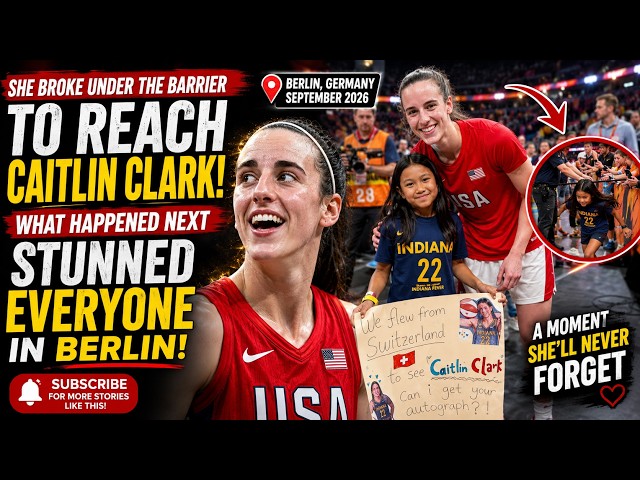
It came after the final buzzer, when Clark stopped near the tunnel and turned her attention toward a young fan who had waited for an opportunity to meet her.
The World Cup in Berlin began with Team USA pursuing another historic championship, with the American program seeking a fifth consecutive world title during another period of enormous expectations.
Clark entered the tournament under a different kind of pressure because this represented her first major senior international tournament with the United States after years of discussion about her national-team future.
The debate had intensified after Clark was left off the United States Olympic roster for the 2024 Paris Games, a decision that generated national headlines and passionate arguments among basketball fans.
Team USA ultimately succeeded without her in Paris, but the discussion surrounding Clark’s absence never completely disappeared because her influence inside American basketball continued expanding rapidly.
Every major international roster conversation eventually returned to the same question. When would one of the most recognizable players in women’s basketball finally receive her chance to represent the senior national team?
Berlin finally provided that opportunity, and Clark responded immediately with a memorable World Cup debut against China.
She finished the game with 14 points and 11 assists while avoiding a single turnover, helping Team USA secure a dominant 94–61 victory.
The performance demonstrated why Clark’s passing can become even more dangerous when she is surrounded by elite finishers capable of converting the opportunities she creates.
Her 11 assists reflected more than basic ball movement because Clark repeatedly manipulated defensive attention before delivering the basketball into scoring positions for teammates.
She also contributed offensively as a scorer, giving Team USA another threat from the perimeter while forcing China to account for her long-range shooting throughout possessions.
According to the source, Clark was named MVP of the match after the victory, adding another significant achievement to an already memorable senior international debut.
For an athlete who had waited through years of debate about her place within USA Basketball, the performance represented a powerful answer delivered directly on the court.
However, the night’s most emotional scene unfolded after the competition had ended.
Team USA players were making their way toward the locker room after completing their opening victory when Clark noticed fans gathered along the barricades near the tunnel.
She could easily have continued walking after a physically demanding international game, and nobody would reasonably have questioned that decision.
Instead, Clark stopped and began signing items for supporters who had gathered hoping for even a brief interaction with one of basketball’s biggest stars.
Among those supporters was a young girl wearing an Indiana Fever shirt with Clark’s name, immediately identifying the player she had traveled to see.
Clark signed a basketball for the young fan, stopped long enough to smile, and posed for a photograph that quickly became more meaningful than an ordinary postgame interaction.
For Clark, the encounter may have lasted less than a minute, but for the young supporter, it created the kind of memory that could remain vivid for decades.
The source describes the scene as part of a broader pattern in Clark’s career, one where her interactions with younger fans repeatedly become some of the most shared moments surrounding her.
That pattern matters because Clark’s influence has developed far beyond ordinary statistics, awards, or box scores.
She has become a crossover sports figure capable of attracting attention from audiences who may not regularly follow professional or international women’s basketball.
Berlin provided another example of that reach because the atmosphere reportedly included international fans cheering specifically for Clark despite Team USA’s traditional status as the dominant opponent.
That kind of reaction is unusual for an American national team that has spent decades becoming one of the most successful programs in international women’s basketball.
The source notes that Team USA entered the tournament having won nine of the previous twelve World Cups while also carrying an extraordinary Olympic record.
Yet Clark’s arrival generated a different atmosphere, with supporters focusing heavily on one player making her senior World Cup debut on foreign soil.
That attention demonstrates the unusual relationship Clark has built with fans.
Her popularity comes from spectacular basketball, but it is reinforced by the sense of personal connection many younger supporters feel when watching her compete.
At Iowa, fans reportedly arrived hours before games simply hoping to see Clark enter the arena.
During her professional career, similar scenes continued around Indiana Fever events and other public appearances.
One example referenced in the source involved Clark taking time at a charity golf event to sign clothing for a two-week-old baby.
Another involved her returning to her former college arena before a preseason game and spending significant time signing shirts, towels, posters, and other items for young supporters.
Clark has publicly acknowledged that she understands such attention is not normal for every athlete and that she does not want to take those experiences for granted.
She has also described being a role model as something meaningful to her, while explaining that the fans themselves can have an emotional impact on her.
That perspective helps explain why moments like the Berlin interaction continue appearing throughout her career rather than looking like isolated publicity opportunities.
The common structure is often remarkably simple.
A young supporter waits, Clark notices the fan, and she chooses to stop despite the schedule, pressure, or physical exhaustion surrounding the moment.
The Berlin interaction also occurred during a period when Clark’s participation in the World Cup had not always appeared guaranteed.
The source notes that injuries during her second WNBA season created uncertainty about whether she would participate internationally at all.
Some observers wondered whether protecting her body for the following professional season might become the more sensible choice.
There was also controversy when Clark was not prominently featured in a USA Basketball training-camp promotional graphic despite her extraordinary recognition within the sport.
That omission generated criticism from fans and commentators who believed the most recognizable player involved should have received greater visibility.
Those questions added another layer of tension before Berlin.
Would Clark be healthy enough to compete effectively, would she secure her roster place, and could her offensive style translate immediately into a senior international environment?
Her first performance answered those questions emphatically.
Fourteen points, eleven assists, no turnovers, and a convincing Team USA victory provided exactly the type of debut Clark’s supporters had imagined.
The emotional moment afterward made the night feel even more complete because it connected her on-court success with the influence she has developed beyond basketball.
The source also describes another, less comfortable side of Clark’s growing fame.
While she and other Team USA figures moved through postgame areas, some supporters reportedly became aggressive in their attempts to attract her attention.
Objects appeared to be tossed toward the players from above, illustrating how enthusiasm around a major sports figure can occasionally become difficult to control.
That detail provides an important contrast with the calmer moment involving the young girl.
Clark’s popularity creates excitement, but enormous fame also produces crowds, security concerns, and situations where boundaries can become less clear.
The image that remained most powerful, however, was not one of disorder.
It was Clark calmly taking time to acknowledge a single supporter during one of the most important nights of her international career.
That interaction helps explain why Clark’s influence cannot be measured only through television ratings, attendance numbers, assists, or points.
Sports fandom is also built through individual experiences.
One autograph can become a framed possession, one photograph can remain in a family for years, and one brief acknowledgment can change how a young fan remembers an entire tournament.
Clark’s presence in Berlin also arrives during a period of extraordinary growth for women’s basketball.
The source describes her star power as one factor drawing new international attention toward games that audiences might otherwise have ignored.
Every person watching a stream, purchasing a ticket, wearing a jersey, or waiting near an arena becomes part of that expansion.
Clark alone cannot account for the entire growth of the sport, but her ability to attract new audiences has clearly become one of the major forces surrounding women’s basketball.
That makes her World Cup participation important beyond Team USA’s championship ambitions.
She is performing for the most successful national program in the sport while simultaneously introducing international women’s basketball to people who may be watching it closely for the first time.
The pressure attached to that position is enormous.
Every game produces new statistical comparisons, every difficult possession becomes a debate, and every interaction with fans can be recorded and distributed globally within minutes.
Clark’s response has generally remained centered on basketball.
She plays, creates, competes, and then allows the moments surrounding the game to develop naturally rather than trying to manufacture them.
Her World Cup debut demonstrated that approach clearly.
She delivered the kind of playmaking performance expected from an elite guard and then quietly created another memorable moment after the scoreboard had already stopped moving.
The young girl in Berlin may eventually forget individual possessions from Team USA’s victory.
She may not remember the exact point differential or every sequence from Clark’s 14-point performance.
But she will almost certainly remember standing near the barricade, seeing Clark turn toward her, receiving a signed basketball, and posing for a photograph beside someone she admired.
That is the emotional power professional athletes can create without changing anything on a scoreboard.
For Clark, the tournament remains far from finished.
Team USA still has championship expectations, difficult opponents ahead, and the pressure of attempting to extend one of international basketball’s most dominant eras.
Clark will likely have more deep three-pointers, highlight assists, difficult games, and moments of intense scrutiny as the competition progresses.
She may also have more interactions like the one in Berlin, where young supporters wait long after games hoping for a brief acknowledgment.
Those scenes may ultimately become an important part of how her international career is remembered.
Championships and statistics define greatness on one level, but influence is also measured by who feels inspired enough to begin watching, playing, or believing because of an athlete.
Clark’s World Cup debut offered both sides at once.
On the floor, she delivered 14 points and 11 assists without committing a turnover.
Away from the floor, she stopped for a young supporter during a chaotic postgame environment and created a memory more personal than any box score.
The source captures why that combination matters.
Clark has waited years for this international opportunity, but Berlin is already becoming about more than simply proving that she belongs on Team USA.
She is participating in a tournament that could further expand the global audience for women’s basketball while helping Team USA pursue another historic world championship.
Every performance therefore carries two stories.
One is about winning basketball games.
The other is about how an athlete with extraordinary visibility chooses to use the moments created by that success.
In Berlin, Clark offered an answer that required less than a minute.
She turned toward the barricade, noticed a young fan wearing her name, signed the basketball, smiled for the photograph, and continued on.
The World Cup scoreboard will eventually be replaced by another result, another tournament, and another season.
But for one young fan in Berlin, Caitlin Clark’s first senior World Cup victory may forever be remembered through a completely different image.
Not the long-range shot.
Not the eleven assists.
Not even the MVP recognition.
The lasting image may simply be Clark stopping, turning around, and showing one supporter that even during the pursuit of history, there was still time to notice her.
