
Paige Bueckers and Caitlin Clark entered the FIBA Women’s World Cup as two of the most recognizable young guards in American basketball.
Yet their most intriguing contribution to Team USA may not come from individual scoring totals.
It could come from how naturally their games fit together.
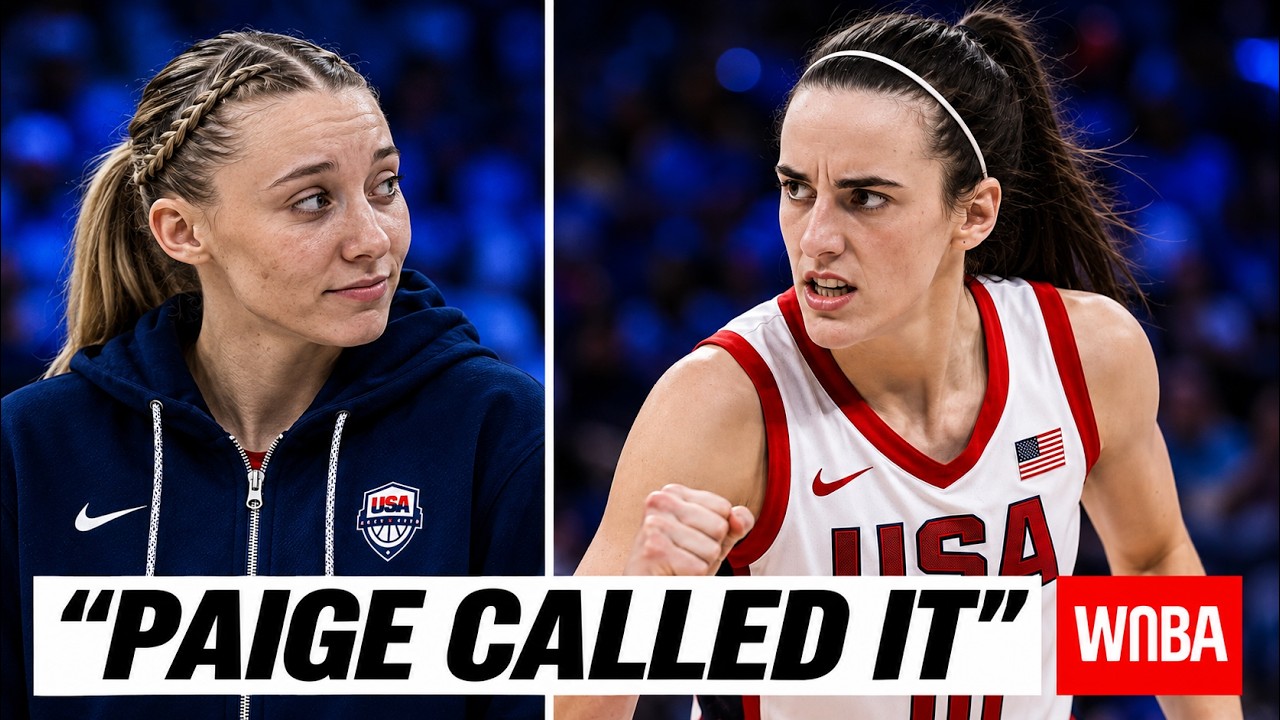
Ahead of Team USA’s next matchup, both guards discussed their history, their relationship, and the basketball chemistry developing between them.
Their answers offered a revealing glimpse into how the American coaching staff could eventually use one of the tournament’s most fascinating backcourt combinations.
Bueckers described the chemistry between herself and Clark as natural and organic.
She explained that even though considerable time had passed since they last played together, sharing the floor again felt almost as though no time had passed.
That statement may sound like an ordinary compliment between teammates.
Tactically, however, it reveals something much more important.
Bueckers appears to understand exactly what she should do when Clark controls the basketball.
She emphasized running the floor.
She emphasized cutting.
She emphasized moving without the ball and becoming available when Clark attracts defensive attention.
Those details provide a blueprint for why this pairing could become extremely difficult to defend.
Clark has spent much of her basketball career functioning as a primary creator.
She controls tempo, initiates actions, stretches defenses with extreme shooting range, and searches constantly for passing opportunities.
Bueckers can also operate with the basketball.
But unlike many elite guards accustomed to dominating possession, she has developed into an exceptionally effective off-ball player.
That distinction creates compatibility instead of competition.
Two great guards sharing the floor can sometimes create a problem if both require the basketball on every possession.
The offense can become stagnant while one player creates and the other simply waits.
Clark and Bueckers potentially avoid that issue.
When Clark initiates, Bueckers can become a cutter, shooter, secondary creator, or transition target.
When Bueckers takes control, Clark can space the defense far beyond the three-point line and create room for everybody else.
That ability to alternate responsibilities could make Team USA’s offense far more difficult to predict.
Bueckers explained the concept herself in remarkably simple terms.
Playing beside Clark means running the floor, moving into open areas, and trusting that Clark will recognize the opportunity.
It sounds basic.
At the highest level of basketball, it is anything but basic.
Timing an off-ball cut requires understanding where defenders are looking, how the ball handler is reading the floor, and when an opening will appear.
Elite passers can see those openings before they fully develop.
Elite cutters understand how to create them.
When those two skills meet, defenses can collapse remarkably quickly.
Clark praised Bueckers from the opposite perspective.
She called Bueckers one of the best off-ball players in the league and highlighted her cutting ability and understanding of the game.
That compliment reveals what Clark values from a teammate.
She does not necessarily need another guard waiting beside her for an isolation possession.
She needs movement.
A player who cuts intelligently gives Clark something to attack with her passing.
A player standing still gives the defense time to organize.
The distinction becomes especially important in transition.
When Clark brings the basketball quickly across half court, defenders already have several problems.
They must respect her ability to shoot from distances most guards would not consider.
They must prevent penetration.
They must also track every American player sprinting toward open space.
Now add Bueckers moving without the ball.
One defender stepping toward Clark can suddenly create a cutting lane behind the first line of pressure.
If another defender rotates early, Clark can pass toward the newly opened area.
If nobody helps, Clark can attack herself.
That sequence forces several decisions before the defense has completely established its structure.
Team USA possesses enough talent to punish virtually every incorrect choice.
This is why the Clark-Bueckers pairing could become more valuable than simply adding two famous names together.
Their skills address different parts of the same possession.
Clark can manipulate defensive positioning.
Bueckers can exploit the movement that manipulation creates.
The process also works in reverse.
Bueckers can attack the middle of the floor while Clark relocates toward deep shooting areas.
Defenders must then decide whether to help against Bueckers or remain attached to Clark several feet beyond the arc.
That type of spacing can create enormous driving lanes.
It can also generate easier opportunities for Team USA’s frontcourt players.
Aliyah Boston was another player discussed during the media availability.
Bueckers praised Boston’s screening, defense, rolling, and expanding three-point ability.
That adds a third dimension to the potential guard combination.
Imagine Boston screening for Clark while Bueckers cuts behind the defense.
The defender guarding Clark must deal with the screen.
Boston’s defender must determine how aggressively to help.
Bueckers’ defender cannot lose sight of her movement.
Every choice creates another opening.
That is the kind of interconnected basketball Team USA is attempting to develop.
The roster already possesses extraordinary individual talent.
The challenge is transforming that talent into combinations where players make one another better.
Bueckers’ comments suggest she understands that principle clearly.
She did not describe playing beside Clark as a battle for control.
She described adapting to Clark’s strengths.
That willingness could be enormously important.
Bueckers has spent much of her career proving she can become the main offensive option herself.
She does not need Team USA to confirm that reputation.
Instead, international basketball gives her an opportunity to demonstrate another level of versatility.
Great national teams require stars to perform roles smaller than those they hold professionally.
A player who averages twenty points elsewhere may take eight shots.
A primary ball handler may spend several possessions cutting or defending.
A dominant scorer may become a secondary creator.
Accepting those changes often determines whether a talented roster becomes a championship team.
Clark acknowledged the same reality when discussing her own role.
She noted that international competition differs from the WNBA and that her responsibilities with Team USA may not resemble exactly what she does for Indiana.
That adjustment matters because Team USA does not need Clark to monopolize every possession.
It needs her to maximize the possessions where her unique strengths create the largest advantage.
The same logic applies to Bueckers.
Team USA does not need her to chase a specific scoring total every night.
It needs her to attack when opportunities appear and move intelligently when someone else controls the offense.
That flexibility could make the pair especially effective.
Their history together also matters.
Clark and Bueckers did not first meet during this World Cup training camp.
They competed around the same basketball environments while growing up and also shared USA Basketball experiences at the youth level.
The source highlights their previous time within American youth teams and their long history of both competing against and playing alongside each other.
That familiarity can shorten the learning process.
Players who understand each other’s tendencies do not always need extended verbal communication.
A glance can signal a cut.
A defender turning her head can trigger movement.
A transition lane can become obvious to both players simultaneously.
Bueckers’ comment that playing together feels almost unchanged suggests some of those instincts remain.
That does not mean the chemistry is already perfect.
Professional basketball has changed both players substantially.
Clark has become accustomed to NBA-style defensive attention surrounding her long-range shooting and playmaking.
Bueckers has developed her own professional identity and decision-making habits.
Their Team USA roles will continue evolving.
But the foundation appears unusually strong for two stars who spend most of the year playing on different teams.
That could become important when Team USA faces stronger opponents.
Against overmatched teams, individual talent may be enough.
Against elite international defenses, chemistry becomes increasingly important.
One late cut can decide a possession.
One extra pass can determine whether a three-pointer is contested or wide open.
One moment of defensive confusion can change the final minutes of a close game.
The strongest backcourts create those moments repeatedly.
Clark and Bueckers possess the tools to do exactly that.
Clark’s passing remains central to the equation.
Bueckers did not praise Clark simply because she can score.
She focused on what playing beside Clark allows teammates to do.
That is a more meaningful description of elite point guard play.
The best creators do not merely accumulate assists.
They change teammate behavior.
Players run harder because they know the passer will find them.
Cutters become more aggressive because they trust that openings will be recognized.
Screeners roll with greater purpose because the ball handler understands the timing.
Clark can create that confidence.
Bueckers appears ready to take advantage of it.
That is why her off-ball ability becomes so valuable.
A defender cannot simply watch Clark and hope to recover afterward.
Bueckers is too intelligent a mover.
One moment of lost attention may be enough for her to reach the basket or receive an open jumper.
The half-court possibilities may be even more interesting than transition.
International defenses often require guards to process crowded spaces quickly.
Ball movement and cutting become essential when opponents successfully slow transition opportunities.
Clark’s ability to identify passing angles gives Team USA a major weapon in those situations.
Bueckers’ ability to move before the opening exists makes that weapon more dangerous.
One player sees the space.
The other creates it.
That partnership can become extremely difficult to scout because the defense cannot rely on one predetermined action.
Bueckers can cut.
She can relocate.
She can handle after receiving the pass.
She can attack the closeout.
She can become the secondary passer.
Clark can also shift responsibilities during the same possession.
That kind of versatility is far more dangerous than two guards simply taking turns isolating defenders.
The source strongly advocates making Clark and Bueckers Team USA’s starting backcourt.
That remains an opinion rather than a settled coaching decision.
Veterans such as Chelsea Gray provide experience, control, and championship knowledge that remain valuable.
The real evaluation should therefore focus less on age and more on lineup fit.
Which combinations create the best spacing?
Which groups generate the strongest defensive pressure?
Who protects the basketball?
Who makes the offense easiest for teammates?
Who deserves to finish close games?
Those questions become increasingly important as Team USA progresses through the tournament.
Starting carries symbolic value.
Closing carries competitive value.
Clark and Bueckers could potentially become one of Lawson’s most dangerous late-game options even if rotations change from matchup to matchup.
The pair also represents something larger about the future of USA Basketball.
Both are part of a generation that grew up competing within an increasingly visible women’s basketball environment.
They have played against one another.
They have represented the United States together.
They have become professional stars through different paths.
Now they are sharing the senior international stage with championship expectations.
That transition carries enormous pressure.
Team USA is not treating the World Cup as an exhibition.
The program expects to win.
Veterans including Breanna Stewart and Chelsea Gray provide institutional memory from previous international successes.
Younger players must find ways to contribute without assuming their professional roles automatically transfer to the national team.
Bueckers’ comments suggest she understands that responsibility.
She repeatedly emphasized gratitude, humility, and learning from veterans.
At the same time, her basketball explanation showed confidence.
She understands exactly how she can help when Clark controls the game.
That combination of humility and tactical awareness is valuable.
Clark also appears comfortable with the partnership.
She described playing with Bueckers as fun and praised the natural chemistry developing between them.
The important phrase may be “more and more momentum.”
Chemistry does not remain static.
Every possession provides additional information.
Clark learns where Bueckers prefers to cut.
Bueckers learns when Clark looks for transition passes.
Both learn how defenders react when they share the floor.
Those repetitions can transform basic compatibility into elite coordination.
The most exciting part for Team USA may be that neither player requires the other to become something unnatural.
Clark does not need Bueckers to become a stationary shooter.
Bueckers does not need Clark to stop creating.
Each can remain within the strengths that already made her successful.
That is the definition of complementary talent.
The source includes speculation about previous friction and even an alleged apology between the players.
Those claims are not independently established within the material and are far less important than the direct comments both players made publicly.
Their own words describe mutual respect and basketball compatibility.
That is the evidence Team USA actually needs.
Online narratives can continue debating old professional games.
International competition creates a much simpler priority.
Win.
If Clark and Bueckers help Team USA do that together, whatever happened during previous WNBA matchups becomes secondary.
That same principle applies to Angel Reese and every other young American star.
Professional rivalries do not disappear completely, but national-team basketball changes the incentives.
Players who normally compete for standings, awards, attention, or playoff positions suddenly share the same goal.
That environment can create partnerships fans never expected to see.
Clark and Bueckers may become the clearest example.
Their potential is not based solely on celebrity.
It is based on basketball logic.
One is an extraordinary on-ball manipulator.
The other is an elite off-ball mover who can also become a primary creator whenever necessary.
Both can score.
Both can pass.
Both understand spacing.
Both can punish defenders for concentrating too heavily on the other.
That creates the foundation for a backcourt capable of attacking almost every defensive strategy.
Pressure Clark, and Bueckers moves into the opening.
Stay attached to Bueckers, and Clark receives more room.
Switch aggressively, and both can attack mismatches.
Trap the ball, and one becomes the release valve.
The formula sounds straightforward.
Executing it consistently is the challenge.
Team USA now has an entire World Cup to discover how far the partnership can develop.
The strongest signal so far came directly from Bueckers.
When Caitlin Clark has the basketball, run.
Cut.
Move.
Stay ready.
Clark’s response was equally revealing.
She sees Bueckers as one of basketball’s best players away from the ball.
Those two observations fit together almost perfectly.
And if that chemistry continues growing, Team USA may discover that its most dangerous backcourt was not created by asking two superstars to share control.
It may be created by allowing each superstar to make the other one harder to guard.
